
Casinos That Accept Google Pay in Australia: What to Check
 Available in AU
Everyday Google Pay use in Australia does not confirm that an online casino accepts it or supports a particular withdrawal.
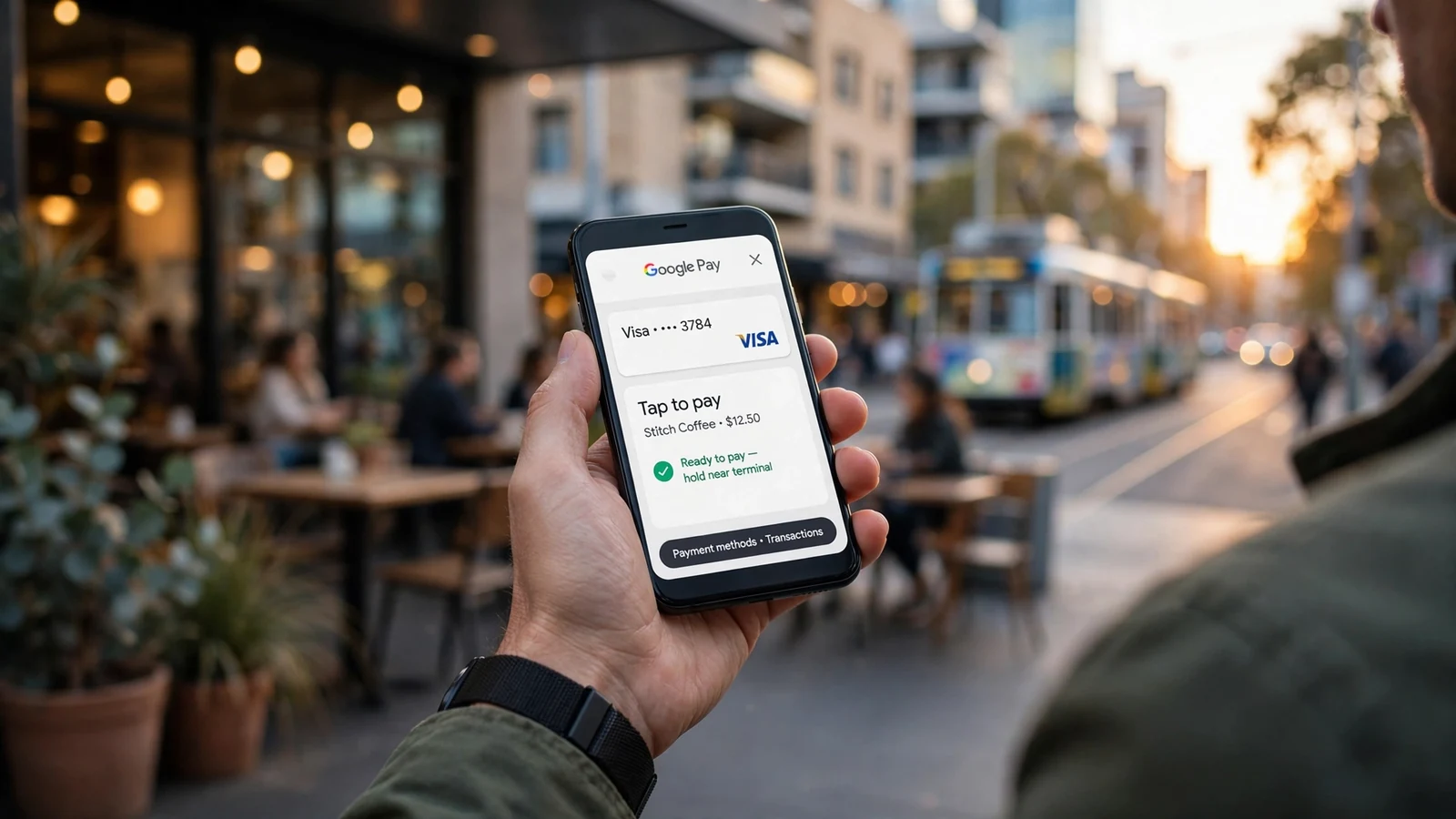
Table of Contents
- Google Pay in Australia: Everyday Use Isn’t Casino Acceptance
- What a Google Pay Deposit Claim Actually Tells You
- Checking Payment Claims Without a Casino Shortlist
- Instant Withdrawals: What the Available Evidence Doesn’t Establish
- The Australian Legal Context for Offshore Casino Searches
- A Payment Wallet Does Not Identify Which Games Are Available
- Google Pay and Slot Searches: Keep the Claims in Bounds
- Withdrawal Checks Before You Rely on a Payment Label
- Australian Payment Habits and Casino Payment Assumptions
- Google Pay Casino Searches: What Can Be Confirmed
Google Pay in Australia: Everyday Use Isn’t Casino Acceptance
Tap-to-pay is part of ordinary life in Australia. Google Pay and Apple Pay are accepted by businesses across almost the whole country, so it makes sense that you might expect to see the same options when paying online. But a familiar wallet at a shop counter tells you nothing definite about whether a particular online gambling site accepts it.
That distinction is easy to miss. You may have used Google Pay for everyday purchases and assume that an online cashier will offer it too. The name of the wallet is the same, but acceptance is not universal across every kind of business. A payment option has to be available for the specific service and transaction in question. Broad acceptance around Australia does not establish acceptance by an online casino.
I’d keep those two ideas separate: Google Pay is widely used locally; a specific casino’s payment options are a different matter. One does not prove the other.
Familiar wallet, different setting
At a shop, you can often see the contactless terminal and choose how to pay at the point of sale. Online, you are dealing with a cashier interface rather than a physical checkout. Seeing Google Pay in one setting does not tell you what will appear in another, and a logo on a general payment page should not be treated as proof that the wallet is available for every service.
If you’re considering a casino for Google Pay in Australia, check that the payment method is currently available to you before depositing. These brief verdicts highlight the operator details provided, without assuming Google Pay support.
Payout speed: crypto ~90 minutes, fiat 1-5 days · Min. deposit: A$30 You’ll find a stated minimum deposit of A$30. Payouts are listed at around 90 minutes for crypto and 1–5 days for fiat.
License: Curacao Gaming Control Board OGL/2023/176/0095 (Hollycorn N.V.) You can note its stated Curacao Gaming Control Board licence, OGL/2023/176/0095, held by Hollycorn N.V.
License: Curacao eGaming (Hollycorn N.V., since 2017) · Min. deposit: A$20-30 (depends on the offer) You’ll find a stated Curacao eGaming licence held by Hollycorn N.V. since 2017. The minimum deposit is A$20–30, depending on the offer.
License: Curacao · Min. deposit: A$20 (POLi) You’ll find a stated Curacao licence and a A$20 minimum deposit for POLi.
License: Curacao Gaming Control Board OGL/2023/174/0082 (Dama N.V.) You can note its stated Curacao Gaming Control Board licence, OGL/2023/174/0082, held by Dama N.V.
License: Curacao eGaming (Roby Games Ltd) You can note its stated Curacao eGaming licence, held by Roby Games Ltd.
License: Curacao eGaming OGL/2024/923/0383 (Antillephone N.V.) · Min. deposit: A$30 You’ll find a stated Curacao eGaming licence, OGL/2024/923/0383, held by Antillephone N.V., and a A$30 minimum deposit.
Payout speed: crypto 30-120 minutes, fiat 24-72 hours · Min. deposit: A$30 You’ll find a stated minimum deposit of A$30. Payouts are listed at 30–120 minutes for crypto and 24–72 hours for fiat.
License: Curacao You can note its stated Curacao licence; no deposit or payout details are provided here.
License: Curacao (operating since 2017) · Min. deposit: A$20 You’ll find a stated Curacao licence and that the operator has been operating since 2017. Its minimum deposit is A$20.
That is why broad phrases such as “Google Pay is accepted in Australia” need to be read carefully. They describe everyday availability across the country, not a guarantee for every merchant or category of transaction. The claim can be true at a national level while still leaving the specific online service unanswered.
When you are looking at an Australian online casino, the useful question is not whether Australians can use Google Pay generally. They can use the wallet widely in everyday settings. The useful question is whether that particular cashier offers it for the transaction you have in mind. Without that distinction, a familiar payment brand can look like confirmation when it is only context.
Don’t let the label do the work
A payment logo or a mention of Google Pay may catch your eye, but the label alone does not explain how the option applies. It does not establish that the wallet is available to Australian customers, that it appears in the cashier, or that it applies to every kind of payment. Those details belong to the particular service, not to the wallet’s general popularity.

I would avoid turning a broad statement about mobile payments into a conclusion about a gambling site. That is not being fussy; it is simply keeping the claim within its limits. “Used widely in Australia” and “accepted by this casino” are different statements, and the first cannot stand in for the second.
The same caution applies when several payment brands are grouped together. A page may mention mobile wallets as a category, but that does not show that each named wallet is available in the same place or for the same transaction. Treating a category label as a confirmed option can lead you to read more into it than it says.
A sensible way to read the topic
If you are trying to understand whether an Australian online casino accepts Google Pay, start with the wording about that specific service rather than relying on how common the wallet is elsewhere. Keep the scope narrow. General information about Australian shopping habits can explain why the option feels familiar, but it cannot confirm an individual cashier’s setup.


This matters because familiar technology creates an easy shortcut in your thinking: “I use it everywhere, so it should work here too.” That shortcut is understandable, but it is not evidence. Everyday acceptance gives you a reason to recognise Google Pay as a common local payment method; it does not settle what an online gambling service supports.
Nor does the phrase “Australian casino” change the distinction. A service described as Australian-facing is not automatically shown to accept every payment method used by Australians. The wording may describe an intended audience, while the payment claim still needs to refer to the actual cashier. Keep those claims separate rather than letting one imply the other.
So, when you see Google Pay mentioned alongside online casino wording, read it as a claim that needs to be specific to the service, not as a consequence of the wallet’s widespread use. Australia’s everyday familiarity with mobile wallets is real. Casino acceptance is a separate question. Don’t merge them.
What a Google Pay Deposit Claim Actually Tells You
A statement that a casino accepts Google Pay for deposits tells you, at most, that the site is making a claim about a payment option. It does not, by itself, tell you whether that option is available to you, whether a payment will go through, or what the cashier will show when you try to use it.
That distinction matters because the familiar name of a wallet can make a payment route sound settled. It is not. A deposit depends on the route actually presented for that transaction, not just on a label in a headline or a general payment-method description.
Australians are comfortable moving between cards, mobile wallets and bank-linked services such as PayPal. That familiarity makes it easy to read a wallet name as a promise of compatibility. But being able to use a mobile wallet in everyday life does not establish that a particular online service accepts it. The consumer habit and the site’s payment claim are separate things.


What “accepts Google Pay” leaves unanswered
The wording can cover different levels of certainty. A page might mention Google Pay as a method, describe it as an option, or make a broad statement about deposits. Those phrases do not all show the same thing. A general mention is not the same as seeing Google Pay offered as a selectable method for your account and transaction.
Even seeing a payment method listed would answer only a narrow question: whether the site presents that method in that context. It would not establish that every customer sees the same choice or that a particular payment succeeds. A claim should be read as a claim, not expanded into assurances the wording does not provide.
This is why “casino deposit via Google Pay” is not a single fixed experience. The phrase describes an intended route, but it does not tell you the conditions attached to it. The cashier is where a deposit option would need to be presented for the transaction in question. A reference elsewhere on a site may be out of date, broad, or simply less specific than the cashier display.

There is no need to turn that into a guess about what happens behind the scenes. If the route is not clearly shown when you are considering a deposit, the name alone cannot fill in the blanks. That is a useful boundary, not a technical mystery.
Read the claim at face value
A careful reading separates three things: what a page says, what the cashier presents, and what the payment outcome is. They are related, but one does not automatically prove the next. A site can state that it accepts a wallet without that statement confirming the exact route available to every visitor. A displayed option, in turn, is not a guarantee of approval.
That is also why a claim about a “Google Pay deposit” should not be treated as proof that Google Pay will appear at checkout. The claim may tell you what the site intends to support or how it describes its services. To know what choice is actually offered, you would need to see the payment options presented for the transaction itself. No headline can do that job for you.
- Report a statement that a site says it supports Google Pay
- Confirm the payment route directly in the cashier
- Assert that a route is available based on a headline
- Treat a general claim as proof of personal usability
Keep the wording narrow. “The site says it supports Google Pay” is different from “I can deposit with Google Pay here.” The first reports a statement. The second asserts that the route is available and usable in your case. Unless you have confirmed the latter directly, stick with the former.
Don’t let a small deposit figure distract you
A search for a small Google Pay deposit can make the amount look like the main question. But an amount in a phrase does not verify that Google Pay is accepted, that it will appear in the cashier, or that the transaction will be processed. The payment-method claim and the amount are separate details; one cannot establish the other.
If a page mentions a minimum deposit alongside a wallet name, read those as two claims rather than treating them as a single confirmed offer. The amount may refer to a general deposit condition, while the wallet reference may describe a method without showing whether it is available for that specific transaction. A neat sentence is not the same as a completed payment route.
The same care applies to labels such as “best” or “accepts deposits.” They can sound conclusive, but they do not tell you how the statement was checked or how current it is. A confident label still needs to be understood for what it says—and no more.
So, when you see a Google Pay deposit claim, take it as a starting point for checking the payment option, not as proof that you can use it. Look for the method in the cashier and read the wording precisely. If it is only mentioned in general terms, keep your conclusion just as general. Plain enough.

Checking Payment Claims Without a Casino Shortlist
A payment badge can look definitive until you try to work out what it actually promises. When a site says it accepts Google Pay, check the wording and where it appears before treating it as a confirmed option. A logo in a general payment graphic may not tell you whether the wallet is available for the transaction you have in mind.
Start with the site’s own current payment information, rather than a search result or an old review. Look for Google Pay named explicitly, and read the surrounding explanation. Does the statement refer to payments generally, or specifically to deposits? Is it presented as an available method for Australian users, or is the page written for a broader audience? If the wording leaves those points open, the claim leaves them open too.
Then compare that description with what the site shows in its cashier. The cashier is where a payment option should be made clear for the account and transaction at hand. If Google Pay is not shown there, a logo elsewhere should not be treated as proof that it can be selected. If the information conflicts, pause rather than guessing which version is right.
That is a practical way to assess claims without relying on a list of sites labelled “best”. Rankings can bundle together different kinds of statements: a site may be described as accepting a wallet, while the supporting detail refers only to a general payment page or an older account of its options. A ranking does not resolve that gap. The useful question is whether the operator’s own current information clearly matches the claim being made.
Checking Payment Claims
Start with the site’s own payment information rather than search results or old reviews.
Compare the description with the options actually presented in the cashier for your account.
Ask the support team to confirm the point in writing if the explanation is vague.
Be precise about what “accepts Google Pay” means. A method may be mentioned without being available for every transaction or every customer. Do not assume that a reference to a wallet means it is enabled for your account, or that being able to open a payment screen means the transaction will be approved. Those are separate steps, and the wording should not blur them.
Account checks matter as well. Online casinos commonly require customers to pass a Know Your Customer assessment before they can carry out financial transactions. That means payment information should be read alongside any account-verification requirements, not as a promise that a payment will proceed automatically. Keep the distinction clear: a stated method describes an option; it does not remove other conditions attached to using an account.
I would also pay attention to how specific the claim is. “Google Pay available” is less informative than a clear statement identifying the relevant transaction and who can use it. If the explanation is vague, look for clarification in the operator’s own published terms or ask its support team to confirm the point in writing. A response should answer the question directly, not redirect you to a generic page full of payment logos.
Keep a copy of the wording you relied on, along with any reply you receive. Payment pages can change, so a record helps you distinguish what was stated at the time from what appears later. It is not a guarantee of acceptance; it is simply a way to avoid relying on memory when two pieces of information do not match.
If a claim cannot be checked against clear, current information, treat it as unconfirmed. That is not a shortlist, and it is not a recommendation. It is just a cleaner standard for reading payment claims: identify exactly what is being offered, where the claim comes from, and whether the cashier and account terms support the same interpretation. Better to stop at a vague label than build an expectation on it.

Instant Withdrawals: What the Available Evidence Doesn’t Establish
“Instant Google Pay withdrawal” sounds like a single payment feature. It actually combines two separate claims: that Google Pay can be used to receive a payout, and that the payout arrives immediately. Neither follows simply from a site showing Google Pay as a way to pay in.
A deposit and a withdrawal are different transactions. Money paid in through a wallet does not, by itself, tell you how winnings would be returned. The service handling the incoming payment may not be the route used for an outgoing one, and a payment label alone does not explain the operator’s payout arrangements. Deposit acceptance is not a promise of matching withdrawals.
Speed is another separate question. “Instant” can sound straightforward, but a payout may involve stages beyond the payment method itself. A request could be subject to review before it is processed, and the time for funds to reach an account can depend on the route used. Without a stated, applicable timeframe, there is no sound basis for treating an instant-payout claim as a dependable arrival time.
That distinction matters if you are comparing claims about Google Pay withdrawals in Australia. A page may use the wallet’s name prominently while saying little about whether it applies to payouts. Read the wording closely: does it describe deposits, withdrawals, or both? Does it name Google Pay as the receiving method, or merely show it among payment options? Those statements are not interchangeable.
I would also treat “instant” as a claim to clarify, not a guarantee to build a plan around. It could refer to the operator approving a request, rather than money appearing in your chosen account. It could also be a broad description that does not explain what happens in a particular case. The label is only useful when the route and meaning of the timing are clear.
A careful reading keeps the questions separate:
- Is Google Pay identified as a withdrawal route, rather than only a deposit option?
- Does the wording explain what “instant” measures?
- Is the claim specific to the circumstances that apply to you?
If those points are blurred, the phrase does not tell you when funds would arrive—or even whether Google Pay is the route for receiving them. That is a practical limit, not a minor detail.
I would not treat “instant Google Pay withdrawal” as a settled description just because it appears in a headline or payment badge. A visible wallet logo can be easy to read as an all-purpose promise. It isn’t. A claim about fast deposits cannot fill the gap, and neither can the fact that mobile wallets are familiar to Australian consumers.
Keep the wording in proportion: a withdrawal claim needs to say that the wallet supports payouts, while a speed claim needs to explain what happens and when. If a page does not make those points clear, the word “instant” tells you less than it seems. No shortcut there.
The Australian Legal Context for Offshore Casino Searches
A payment label does not change the legal position. Under the Interactive Gambling Act 2001, operators cannot provide real-money online casino games to people physically located in Australia. That applies whether a site describes itself as offshore, lists a foreign licence, or presents Google Pay as a cashier option. A payment method is not an exemption from the law.

The Act places the prohibition on the operator. It does not explicitly make an Australian player’s use of an offshore casino a criminal offence. That distinction matters: it explains who the law targets, but it is not an endorsement of using such a service or a promise that doing so is risk-free. Nor does an operator’s willingness to accept a payment establish that its service is lawful to offer in Australia.
The Australian Communications and Media Authority, or ACMA, is responsible for enforcing the Act. Its role is to enforce the rules governing prohibited interactive gambling services. For someone looking at a site that claims to accept Google Pay, the practical point is simple: the presence of a familiar wallet does not tell you whether the underlying casino service may lawfully be provided to people in Australia.
There is a separate consumer issue. Australian consumer law does not protect players who use offshore casinos. If a dispute arises over an account, a payment, or winnings, you should not assume that the protections available in a domestic consumer transaction will apply. A site’s polished presentation or payment branding does not create Australian consumer protection.
That leaves two questions which are easy to blur together: whether a payment route is offered, and whether the service itself may be offered to people in Australia. The first is a commercial claim made by a site; the second is governed by Australian law. Treating one as proof of the other is a poor shortcut.
Legal Risk
Under the Interactive Gambling Act 2001, operators cannot legally provide real-money online casino games to people in Australia, regardless of the payment methods offered.
If you come across a casino that says it takes Google Pay, read that statement narrowly. It may describe a payment feature, but it does not establish that the operator can legally provide real-money casino games to you in Australia, or that Australian consumer law will protect you if something goes wrong. A foreign licence, if mentioned, does not alter the Australian prohibition on operators providing these services to people physically here.
The useful distinction is not complicated, even if sites sometimes make it look that way: the Act addresses operators, ACMA enforces it, and the absence of an explicitly stated player offence is not a consumer safeguard. Keep those points separate from payment claims. A wallet label answers a narrow question about payment; it does not settle the legal or consumer-protection questions around an offshore casino.
A Payment Wallet Does Not Identify Which Games Are Available
A payment option and a game catalogue answer different questions. Seeing Google Pay mentioned alongside a casino service does not tell you what that service offers, how its catalogue is organised, or whether particular titles are available to you. A wallet is a way to move money; it is not a label for the content connected to an account.

That distinction can be easy to miss on a small screen. A page may place payment details near general information about games, making the two look like one package. They are not. A payment logo cannot confirm the catalogue, and a catalogue description cannot establish that Google Pay is available. Each claim needs to be read on its own terms.
Google Pay and Apple Pay are accepted almost everywhere in Australia for everyday purchases. That broad familiarity is useful context, but it says nothing about the content or payment arrangements of a particular online service. Familiar in a shop does not mean available in every other setting.
When a page says that Google Pay is supported, read that as a statement about a payment option only. Do not extend it to mean that all content is accessible, that a particular title can be opened, or that the payment method is tied to any one game. Those are separate questions, and the wallet label does not settle them.
The reverse is true as well. A page describing its content does not, by itself, show that Google Pay can be used there. It is tempting to join the two claims because they appear together, but proximity is not proof. Small detail, big difference.
For a newcomer, the practical habit is simple: keep payment information and content information in separate mental boxes. Treat a wallet name as a payment statement, not as a catalogue guide or a promise about access. If a page blends the topics, its wording still needs to support each claim independently.
So a mobile payment reference cannot identify which games are available. Nor can it tell you whether any specific content is offered or accessible. The only safe reading is the narrow one: the page is making a claim about a payment method, and that claim does not answer a different question about content.
Google Pay and Slot Searches: Keep the Claims in Bounds
A wallet label and a game description answer different questions. Google Pay being common in Australian shops does not show that it can be used for a gambling payment, and it says nothing about which games a site provides. Those details need to be treated separately.

Across Australia, paying with a phone is ordinary: Google Pay and Apple Pay are accepted by businesses in almost every part of everyday commerce. That familiarity can make a claim about paying for online casino games sound plausible. But acceptance in shops is not evidence of acceptance by an online gambling service, and it cannot establish a payment route for any particular game.
The same distinction applies when a page pairs Google Pay with pokies. A payment method does not tell you whether a service offers a particular category of game, or whether that wallet would work for it. Nor does a general statement that a business accepts mobile wallets confirm that the wallet is available for every transaction. The label alone carries less information than it may seem to.
Bonus wording needs the same care. A mention of a bonus beside Google Pay does not establish that the payment method qualifies, that an offer is available to you, or what conditions apply. Read the terms directly rather than treating nearby labels as proof. A headline can join ideas without explaining their relationship.

I’d keep the check narrow: distinguish a general mobile-wallet statement from a specific payment claim, and distinguish payment details from descriptions of games or promotions. If those points are blurred together, the claim is not clear enough to rely on. Neat wording, thin evidence.
There is no basis for treating Google Pay as a slot-specific payment option just because mobile wallets are widely used around Australia. Broad familiarity is one thing; acceptance for a particular online transaction is another. Keeping those claims apart makes it easier to see what a payment label does—and does not—tell you.
Withdrawal Checks Before You Rely on a Payment Label
A Google Pay label beside a deposit option does not, by itself, tell you how a withdrawal would work. Depositing and receiving funds are separate transactions, and a payment method shown for one should not be treated as confirmation of the other.
Before relying on a payment label, read the site’s withdrawal terms and look for the actual method, any eligibility conditions and what information you must provide. Check whether the terms distinguish between the way you fund an account and the way money can be returned. If they are unclear, do not assume that Google Pay is available for payouts simply because it appears in a cashier.
There is another requirement to factor in: online casinos typically ask customers to complete a Know Your Customer (KYC) assessment before handling financial transactions. That can involve checks on identity and account details. Read the stated requirements before submitting information or making decisions based on a displayed payment option; an unfinished assessment may affect access to financial transactions.
I’d also check that the withdrawal rules are current and apply to the payment route being described. A generic help page, an old review or a logo on a payment page may not answer the specific question of whether a withdrawal can be made to Google Pay. Look for clear wording in the operator’s own terms, and contact its support team if the route or conditions remain ambiguous. Keep a copy of the relevant terms and any reply, so you can refer back to what was actually stated.
Withdrawal Verification
- Read the site’s withdrawal terms for Google Pay
- Check for eligibility conditions and required information
- Complete the Know Your Customer (KYC) assessment
- Confirm the payout route with the support team
This is a check on the claim, not a promise of a payout route. It does not establish that a casino offers withdrawals through Google Pay, or how a transaction would be handled. Nor does a deposit method tell you what withdrawal methods are available. The useful distinction is simple: confirm the withdrawal conditions separately, including KYC, before treating any payment label as relevant to receiving funds.
Small detail, big difference.
Australian Payment Habits and Casino Payment Assumptions
Australians are used to moving between payment methods. Contactless credit and debit cards are accepted almost everywhere in the country, and mobile wallets such as Google Pay and Apple Pay are familiar parts of everyday spending. People also switch between cards and services linked to their bank, including PayPal, without treating each one as a completely different way to manage money.
That familiarity can make a casino payment label look more meaningful than it is. A method that works at a local shop does not automatically work on an online gambling site. The same goes for a bank-linked service: its everyday use says nothing by itself about whether a particular site accepts it. Familiarity is not confirmation.
I find it helps to separate two questions: what Australians commonly use, and what a site actually says it supports. The first is about local payment habits. The second is specific to the site and cannot be answered by looking at how common a wallet is in Australia. A Google Pay logo or mention, for instance, should not be read as proof that every Australian-facing casino supports it.
Nor does seeing several familiar payment names together make them interchangeable. A card, a mobile wallet and a bank-linked service may each be familiar to the same customer, but they remain distinct payment routes. A site’s wording matters; broad assumptions based on daily life do not fill in the gaps.

So when you see a reference to an Australian casino with Google Pay, keep the claim narrow: it concerns that site’s stated payment options, not a general feature of Australian payment culture. Everyday habits explain why the method feels familiar. They do not establish casino acceptance. Short distinction, big difference.
Google Pay Casino Searches: What Can Be Confirmed
Google Pay is widely accepted across Australia in everyday commerce. That makes it familiar, not universally usable: a wallet accepted at a local shop does not automatically appear as an option in an online casino’s cashier.
So, can you use Google Pay at a casino? There is no blanket answer that applies to every operator. Acceptance depends on the payment options a particular service makes available to Australian customers, and general knowledge about mobile wallets cannot settle that question. I would not treat “Google Pay casino” as a confirmed payment route simply because the wallet is common here.

The same distinction applies when a site mentions mobile payments in broad terms. A wallet name, a contactless symbol or a general statement about digital payments does not, by itself, tell you that Google Pay is supported for a particular transaction. The exact method needs to be stated for that service and for the action you intend to take.
That is the useful boundary: Google Pay is part of ordinary Australian payment life, but that does not prove that any specific casino accepts it. Nor does broad acceptance of mobile wallets let you infer that Google Pay can be used at every gambling site. Familiarity is not confirmation.
If you are weighing a payment claim, look for Google Pay named explicitly in the operator’s own cashier information and terms, rather than relying on a generic wallet label. If it is not clearly listed, do not assume it will work. Payment details can change, so a current, operator-specific statement matters more than a general description of how Australians pay.
In short, Google Pay is common in Australia; casino acceptance is a separate question. Keep those two claims apart. One is an everyday payment fact. The other must be established for the particular service.
How do you check if casino sites accept Amex deposits?
Check the casino’s cashier for American Express as a deposit option. If it is available, select it, enter your card details and the deposit amount in AUD, then submit the payment.
Are there fees for using Amex at online casinos?
Amex deposits typically have no fee, but a casino may add a surcharge, and currency conversion can incur a fee. Withdrawals may also carry a fee, so check the casino’s terms for the specific transaction.
Are there any fees associated with using American Express at online casinos?
Amex deposits typically have no fee, but a casino may add a surcharge, and currency conversion can incur a fee. Withdrawals may also carry a fee, so check the casino’s terms for the specific transaction.
Are there any limits on how much I can deposit or withdraw using American Express?
Yes. Each casino sets its own Amex deposit and withdrawal limits, so check the limits shown by that casino for your payment method.
Prepared by the Wildfortunecaasino.net editorial staff.