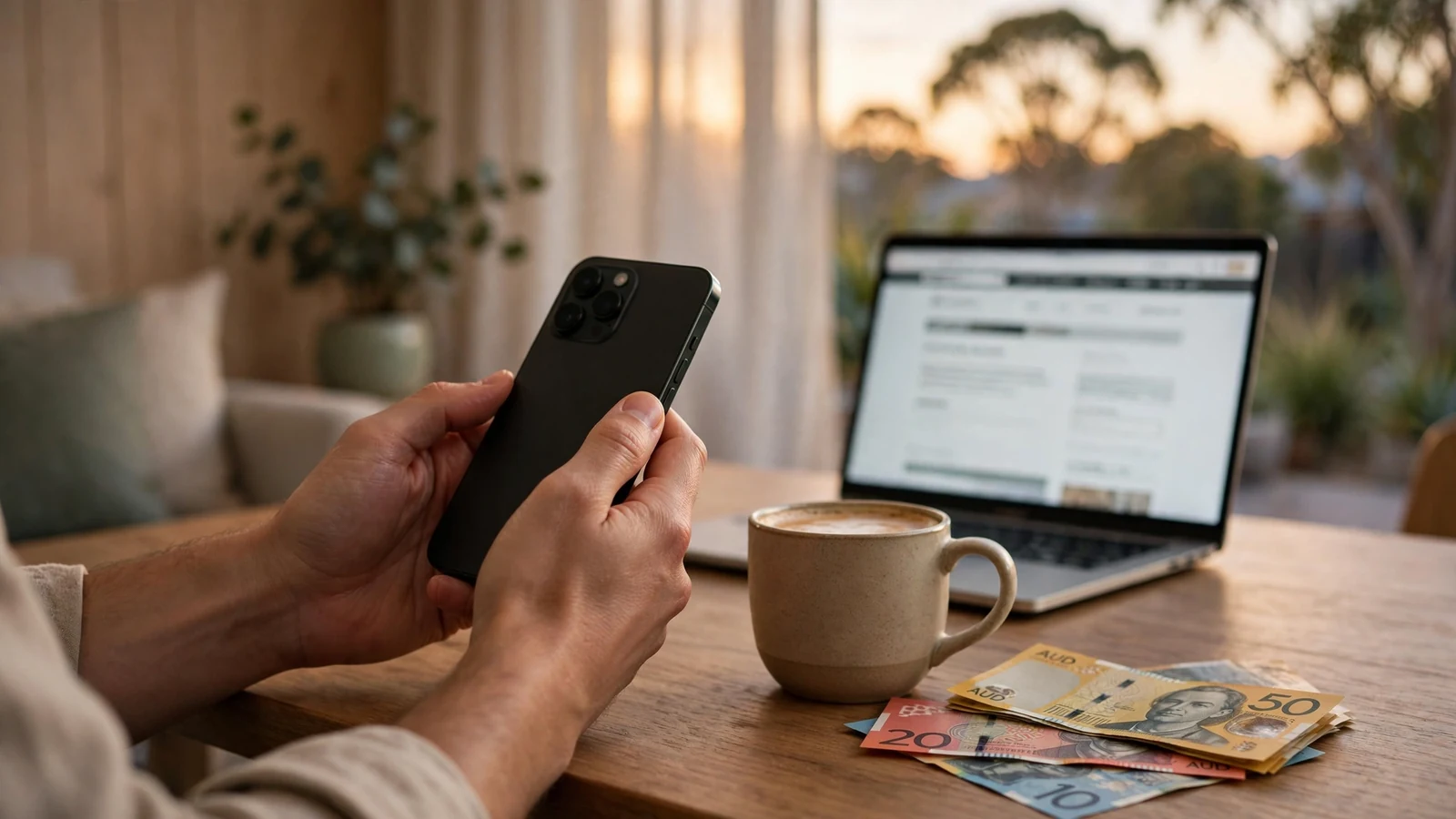
Online Casino Payment Methods for Australians
 Available in AU
Payment labels can hide different deposit and withdrawal rules, while a listed method does not establish that an online casino may legally serve Australians.

Table of Contents
- The payment routes you may encounter—and the Australian limits
- Deposits and cashouts are not mirror images
- PayID in Australia: check both ends of the transaction
- What a payment gateway can—and cannot—tell you
- Carrier billing and SMS payments: verify before you rely on them
- Before using a payment portal, check the cashout route
- Processing times, fees and the paperwork that can hold things up
- “Instant” payments still need a closer look
- Payment apps and wallets: deposit features are not cashout promises
- Paying on a phone without confusing convenience with permission
The payment routes you may encounter—and the Australian limits
Payment menus can make online casino payments look like a simple choice between a bank transfer, an e-wallet, a prepaid voucher or another route. Those categories appear in specialist reviews of payment options, but a familiar name or a neat menu does not make a real-money online casino lawful in Australia.
The legal starting point matters more than the payment label. Under the Interactive Gambling Act 2001, it is illegal for operators to provide real-money online casino games to people in Australia. That includes pokies and table games such as blackjack and roulette. A foreign licence does not change that Australian restriction, and a payment company’s role in processing a transaction does not make the underlying service compliant.
That distinction is easy to miss when you see a page describing “Australian casino payment options”. It may be describing methods listed by an offshore operator, not payment routes for a casino legally authorised to serve people here. Offshore casino services are actively blocked and enforced against in Australia. A payment method’s presence on a website is not evidence that the operator may lawfully provide casino games to you.
Choosing a payment method means looking beyond the deposit step: payout timing and minimum deposits can also affect your experience. Use the details below as a starting point, and check the current cashier terms before you pay.
Payout speed: crypto ~90 minutes, fiat 1-5 days · Min. deposit: A$30 You can deposit from A$30. Crypto payouts are listed at about 90 minutes, while fiat payouts take 1–5 days.
License: Curacao Gaming Control Board OGL/2023/176/0095 (Hollycorn N.V.) The listed detail is its Curacao Gaming Control Board licence, OGL/2023/176/0095, held by Hollycorn N.V. No payment methods or payment timings are specified here.
License: Curacao eGaming (Hollycorn N.V., since 2017) · Min. deposit: A$20-30 (depends on the offer) You can deposit A$20–30, depending on the offer. The casino is listed as licensed by Curacao eGaming through Hollycorn N.V., since 2017.
License: Curacao · Min. deposit: A$20 (POLi) A$20 is the stated minimum deposit for POLi. The listed licence is Curacao.
License: Curacao Gaming Control Board OGL/2023/174/0082 (Dama N.V.) The listed detail is its Curacao Gaming Control Board licence, OGL/2023/174/0082, held by Dama N.V. No payment-specific details are provided.
License: Curacao eGaming (Roby Games Ltd) Roby Casino is listed as licensed by Curacao eGaming through Roby Games Ltd. No deposit minimum, payment methods, or payout timings are specified here.
License: Curacao eGaming OGL/2024/923/0383 (Antillephone N.V.) · Min. deposit: A$30 You can deposit from A$30. Its listed Curacao eGaming licence is OGL/2024/923/0383, held by Antillephone N.V.
Payout speed: crypto 30-120 minutes, fiat 24-72 hours · Min. deposit: A$30 You can deposit from A$30. Crypto payouts are listed at 30–120 minutes, and fiat payouts at 24–72 hours.
License: Curacao The available detail is a Curacao licence; no payment methods, minimum deposit, or payout timings are specified.
License: Curacao (operating since 2017) · Min. deposit: A$20 Uptown Pokies is listed as operating since 2017 and licensed in Curacao. Its stated minimum deposit is A$20.
The categories you may see discussed include bank transfers, e-wallets and prepaid vouchers. Each describes a different way money can move or be held, but the category alone tells you little about whether a particular service is available or lawful. For instance, an e-wallet brand may support some kinds of transactions while excluding others. PayPal has banned gambling transactions in Australia since 2021, so its name should not be read as an invitation to use it for casino payments.
Prepaid products have a straightforward spending boundary: you can spend only the value loaded onto the voucher. That does not turn a prohibited casino service into a permitted one. Nor does the word “prepaid” establish that the product can be used for a particular transaction. The payment route and the legality of the service are separate questions.
You may also come across pages describing cryptocurrency payments, including Bitcoin, or asking whether a digital-currency casino payment is possible. Treat that language carefully. Digital currency is not an acceptable deposit route for online wagering in Australia. A casino site advertising it does not override that limit. Blockchain transfers also cannot be reversed through a card-style chargeback, which makes sending funds a particularly consequential step.

Credit cards and credit-related products are likewise not acceptable deposits for online wagering. A page describing instant card funding or presenting card brands beside other payment choices does not change the Australian restriction. Don’t mistake a transaction that a website claims to accept for one that is permitted here.
Terms such as “phone payment”, or references to services like Revolut or Volt, can also appear in broad payment discussions. The wording alone does not tell you what transaction is supported, where it is available, or whether it relates to a lawful Australian gambling service. A payment solution is only the route for moving money; it is not a permit for the business receiving it.
I’d keep the order clear: first consider whether the service itself may legally provide real-money casino games to people in Australia, then treat payment claims in that light. Sorting through payment labels before that check puts the small detail ahead of the big one. That’s backwards.
Deposits and cashouts are not mirror images
A payment option shown for adding funds does not, by itself, tell you how a withdrawal would work. The two transactions have different jobs: a deposit sends money into an account, while a cashout sends money back out. The route offered for one may not be offered for the other. A specialist review notes that payment methods can differ between deposits and withdrawals, but availability is specific to the service being described and can change.
That distinction matters in Australia, where the Interactive Gambling Act 2001 prohibits operators from providing real-money online casino games to people in the country. A payment screen does not change that legal position. The practical points here are about understanding the mechanics, not choosing a casino or making a deposit.
- Check if a method is listed for deposits
- Check if a method is listed for withdrawals
- Read the specific terms for each direction
- Assume a deposit method works for cashouts
- Assume a cashout option works for deposits
- Treat deposit and withdrawal labels as a paired promise
When a payment method is presented, check which direction it covers. “Deposit” means funds going in; “withdrawal” or “cashout” means funds coming out. A method appearing in a deposit list is not evidence that it can receive a payout. Nor does seeing a cashout option tell you that the same route can be used to fund an account. Treat the two labels as separate information, not as a paired promise.
The difference can affect more than the name of the route. A service may require a withdrawal to be sent through a different channel, or may impose conditions before releasing funds. Read the payment terms alongside the cashout instructions, and look for wording that applies specifically to withdrawals. If the terms only describe deposits, they have not answered the cashout question.
It is also worth distinguishing a payment method from the account or payment details attached to it. A withdrawal may be tied to the person whose identity was verified, or to evidence that a payment method belongs to them. That can mean a method that appeared usable at the start does not settle what information will be needed later. A specialist review says an operator may ask for government-issued identification, proof of address dated within three months, and proof of the payment method. Requirements vary, so the relevant terms matter.


I would read the two sides separately before drawing any conclusion: what is listed for money going in, what is listed for money coming out, and what conditions connect the two. A deposit confirmation only tells you that the incoming transaction was accepted. It does not confirm that a later withdrawal will be accepted through the same route, processed on the same terms, or released without further checks.
Keep a record of the wording you relied on, including any stated restrictions or requirements. Payment pages can be brief, while full terms may explain that a cashout must follow a different process. If the information conflicts or leaves the withdrawal route unclear, that uncertainty is not resolved by the fact that a deposit option is visible.
For Australian readers, this distinction sits within a wider legal boundary: real-money online casino services are prohibited for operators serving people physically located in Australia. A payment mechanism is simply a way of moving funds; it is not evidence that the underlying service is lawful, protected, or available to you. The cleanest reading is the literal one: deposit access describes money going in, and withdrawal access must be established separately. A tidy deposit screen proves very little.
PayID in Australia: check both ends of the transaction
PayID is a way to link an identifier to an Australian bank account through the New Payments Platform. That identifier can be a mobile number, an email address or an ABN. Every major Australian bank supports PayID, but that does not mean every service accepts it—or that a payment to a particular service is lawful.
Legal Restriction
Under the Interactive Gambling Act 2001, operators cannot lawfully provide real-money online casino games to people physically in Australia.
That distinction matters when you see PayID mentioned alongside casino payments. Under the Interactive Gambling Act 2001, operators cannot lawfully provide real-money online casino games to people physically in Australia. That includes pokies and table games. A payment option appearing on a page does not change the legal status of the service.
A PayID label is not a promise
PayID’s bank connection is the straightforward part. The less straightforward part is what a particular operator says it supports. A specialist review of an operator may report that PayID is available for deposits, but that is a report about the operator reviewed, not a guarantee for every site or a standing description of the market. Payment options can change.
More importantly, a deposit option says nothing by itself about cashing out. The same specialist-review distinction applies here: withdrawal support needs to be checked separately for the specific service. I would not read a PayID logo, a mention in a payment list or a successful payment instruction as proof that funds can later be returned through PayID.
There is a practical reason to keep the two ends separate. A payment system can link to your bank account while a service’s own payment rules offer a different route for withdrawals—or no usable route for you at all. The name of a familiar Australian payment method does not settle that question.
What to check—and what not to infer
If you encounter a PayID reference, read the actual terms attached to it rather than relying on a general claim. Look for whether the reference concerns deposits, withdrawals or both, and whether it is specific to the service you are viewing. Treat an unclear or one-sided description as just that: unclear.


But this is not a recommendation to use PayID for online casino play. Australian consumers should not take the presence of a locally familiar payment method as evidence that an offshore casino is authorised to provide real-money games here. Nor does bank support make a prohibited service compliant. Those are separate questions, and the payment label answers neither.
I keep the distinction blunt: PayID connects an identifier to a bank account; it does not certify the recipient. A payment route can be technically available and still be inappropriate to use for a service that cannot lawfully offer casino games to people in Australia. No payment badge fixes that.
What a payment gateway can—and cannot—tell you
A payment gateway is the technical layer that passes payment details between a site and the services involved in processing a transaction. It can display an available route, send a payment request onwards and return a status such as accepted or declined. That is useful information about the transaction. It is not a verdict on whether the service behind the page may legally offer online casino gambling to someone in Australia.
That distinction matters here. Under the Interactive Gambling Act 2001, operators cannot provide real-money online casino games, including pokies and table games, to people physically in Australia. A gateway’s branding, a familiar payment logo or a successful payment message does not change that rule. Payment technology is not a licence, and a completed transaction is not proof that an operator is lawful.
A payment gateway is a technical layer that passes details between a site and processing services; it is not a licence or a verdict on an operator’s legal standing.
A gateway also cannot, by itself, tell you that a route will be available for every transaction. What appears on a payment screen can depend on the operator’s setup and the payment option selected. A specialist review reports that PayID deposit availability depends on the operator and that withdrawal support needs to be checked separately. Treat that as a point to verify, not as a promise that a particular route will be offered.
The same care applies when you see Apple Pay, Google Pay or Klarna mentioned alongside online casino payments. A gateway can present payment choices, but a logo or option shown on a page does not establish that the route is available to you, that it can be used for a particular transaction, or that the operator may legally accept it. Nor does it tell you how you would receive funds back. Apple Pay and Google Pay should not be treated as cashout routes.
I would read a gateway screen as a narrow technical signal: it tells you what the page is attempting to process at that moment. It cannot establish the operator’s legal standing in Australia, guarantee that a payment will go through, or confirm that a separate withdrawal route exists. If the page presents a payment method as proof of trustworthiness, that is a poor substitute for checking the underlying facts.


So, before treating a payment option as meaningful, check the operator’s status through authoritative Australian information and look for a clear statement of the actual withdrawal route. Do not infer permission from access to a payment gateway, or infer cashout support from a deposit option. Those are different questions—and the gateway cannot answer both.
Carrier billing and SMS payments: verify before you rely on them
Carrier billing is different from a bank-linked payment. With phone-based billing, a charge is associated with your mobile service or phone account; a bank-linked route instead moves funds through an account held with a bank. An SMS may be part of how a phone payment is authorised, but receiving or sending a text does not, by itself, tell you where the money goes or what service is being paid for.
That distinction matters when you see a casino payment system described in broad terms. “SMS payment” can sound like a complete route, but the label alone does not establish whether the charge would go onto a phone account, be taken from a linked bank account, or involve another provider. Nor does it tell you whether the service is available to people in Australia. I would not treat a payment logo, a text prompt or a deposit-page description as proof of any of those things.
The legal position comes first: under the Interactive Gambling Act 2001, operators cannot provide real-money online casino games, including pokies, to people physically located in Australia. A phone-based payment option does not change that. This is not a matter of finding a safer way to pay for an offshore casino; a payment mechanism cannot make the underlying service lawful.
Attention: A payment logo, text prompt, or deposit-page description is not proof that a service is available to people in Australia or that the service is lawful.
Searches for CashtoCode, eCheck or casino SMS payments can also lead to assumptions that a named route is available. A name appearing in a payment list, article or promotional page is not enough to establish that it works for an Australian customer, what account it draws on, or whether it is connected to the service being described. I would not infer availability from the name alone.
There is a further practical gap: even when an operator describes a payment option, that does not establish that the same route can be used to receive money. A specialist review has reported that casino payment options can differ between adding funds and withdrawing them; treat that as a report about the operator it covers, not a general rule for the market. A phone charge that appears to support a deposit is not evidence of a corresponding cashout route.
Be wary of the word “safe” when it is attached to a payment method. A payment label cannot establish that the casino is lawful, that a charge can be reversed, or that your money is protected. Before entering phone details or confirming a text-based transaction, establish what account would be charged and who is requesting authorisation. If that information is unclear, stop rather than guessing. A text is not a safeguard.
The same caution applies to claims about payment software: the technology may process an instruction, but it does not tell you whether the underlying gambling service is permitted in Australia. Don’t mistake a working payment screen for permission.

Before using a payment portal, check the cashout route
A payment portal can show what an operator says it accepts, but it does not make the service lawful in Australia. The Interactive Gambling Act 2001 prohibits operators from providing real-money online casino games, including pokies, to people physically in Australia. So treat an offshore casino’s payment page as information about its own process, not as an invitation or a sign that the service is permitted here.
If you are reviewing a portal for another lawful purpose, read the deposit and withdrawal options as separate lists. A method displayed beside “deposit” does not establish that it can be used for a cashout. Look for a distinct withdrawal section, and check whether it names a method you can actually access. A specialist review reports that PayID deposit availability varies by operator and that withdrawal support needs a separate check; the operator’s own current portal is the place to verify its stated options.
Paying via a voucher calls for particular care. A voucher may be listed as a way to add funds, but that does not mean money can be sent back to it. Voucher deposits generally cannot be withdrawn onto the voucher, so a separate cashout route would be needed. If the portal does not explain that route clearly, you do not have a complete picture of the transaction.
Payment Portal Check
- Identify offered deposit methods
- Find the separate cashout route
- Review the conditions for withdrawals
- Verify if a voucher deposit can be withdrawn
I’d also read the labels closely. “Available” may refer only to adding funds, while a withdrawal option can have its own conditions or require a different method. Check that the withdrawal route is named before you proceed; don’t assume you can sort it out after a balance has built up. A payment logo on a page is not the same thing as a confirmed cashout path.
Searches for PayPal, POLi, Boku or Neosurf do not establish that a particular route is available or appropriate. In Australia, PayPal has barred gambling transactions since 2021. For any other method, rely on clear, current information about what the portal supports, and do not treat a brand name or a deposit button as proof of withdrawal access.
The practical check is simple: identify what the portal offers for deposits, then find the separate cashout route and its conditions. If those details are absent or unclear, stop there. And for Australians, that check does not change the legal position: real-money online casino services are prohibited for operators to provide here. No payment screen can alter that.
Processing times, fees and the paperwork that can hold things up
A payment provider can move funds only after the operator has approved a withdrawal, and that review is a separate part of the wait. A specialist review describes bank-transfer withdrawals at some casino operators as being handled manually once or twice a week. On that schedule, a request made on Friday might not reach a bank account until Wednesday. Treat that as a reported example, not a timetable you can count on: processing days depend on the operator’s procedures and the payment route.

The same review reports flat bank-transfer charges of $5–$15 at some casinos. That is an operator fee, separate from any charges your bank might apply. Before relying on a quoted payout time, check whether it begins when you submit the request or only after the operator has approved it. The distinction matters: a transfer can be quick once released and still take longer overall.
For Skrill withdrawals sent to a bank, a specialist review gives a processing estimate of 1–2 days and notes that some casinos add a transaction fee of 1–3%. Neither figure should be treated as a universal Skrill rate. Check the operator’s own withdrawal terms for its fee and timing, and look for any currency conversion charge if the payment is not being handled in Australian dollars. A small percentage can make a noticeable difference to the amount received.
Paperwork can add another pause. A specialist review says an operator may ask for government-issued identification, proof of address dated within three months, and evidence that the payment method belongs to you or is yours to use. That could mean providing documents that connect your identity and address to the account, alongside proof of the funding method. Follow the operator’s secure submission instructions and check that the requested details are clear before sending anything.
Keep the name and details on your payment account consistent with your identity documents where possible. If information does not match, the operator may need to ask for clarification before processing a withdrawal. That is not the same as a bank-transfer delay; it is a verification hold, and changing payment routes midstream may create more questions rather than speed things up.
Processing can be manual (once or twice a week) with operator fees ranging from $5–$15.
Withdrawals to banks typically take 1–2 days, with some operators adding a 1–3% transaction fee.
Operators may require government ID, proof of address (within 3 months), and proof of payment method.
There is a more basic limit for Australians: the Interactive Gambling Act 2001 prohibits operators from providing real-money online casino games to people located in Australia. Timing and fee comparisons do not make such a service lawful or suitable to use. For any legitimate payment service you deal with, the practical lesson remains simple: read its stated fees, timing and document requirements before sending money. No timetable is a promise.
“Instant” payments still need a closer look
A payment marked “instant” describes a claimed processing speed, not whether the route is available to you or lawful to use. Those are separate questions, and mixing them up is an easy way to mistake a fast transaction for a suitable one.
A specialist review describes Visa and Mastercard deposits as instant. That speed claim needs context: Australian financial institutions block many standard transactions on those card networks to offshore casinos. A payment can therefore be advertised as quick while failing at the bank stage. And speed does not make a prohibited payment route acceptable.
There is a broader legal point here, too. Under the Interactive Gambling Act 2001, operators cannot provide real-money online casino games to people physically in Australia. That includes pokies and table games. A payment button, a working integration or a successful transaction does not change that rule.
When you see a payment option presented as instant, read the claim narrowly. It may describe how quickly a deposit is credited after a transaction is approved; it says nothing by itself about whether an Australian bank will approve it, whether the operator can legally offer the service here, or how a withdrawal would work. The word is about speed, not permission.

Payment pages can also group methods together in ways that blur important differences. A site may describe its payment integration as fast, but that wording is not evidence that every listed method is available to Australians or supported by banks here. Names such as Neteller or MiFinity should not be treated as a guarantee of access or instant processing simply because they appear beside that claim.
Interac is another name you may encounter in payment discussions, but a label alone tells you little about whether the route is available in Australia. Check what the payment page actually says, and do not treat a foreign-facing option as an Australian payment route.
I would not use a speed badge as the deciding detail. First establish whether the service itself can lawfully be offered where you are; then assess what the payment wording really promises. A quick deposit claim cannot fix a blocked or prohibited route. Short version: “instant” is not a green light.
Payment apps and wallets: deposit features are not cashout promises
A payment app can make the front end of a transaction feel simple, but that tells you little about getting money back out. Apple Pay is a good example: a specialist review describes deposits being authorised through a phone’s digital wallet and biometric check. That is a deposit feature, not a cashout route. Don’t treat a wallet button at checkout as evidence that the same app can receive a withdrawal.
Wallet Deposit vs. Cashout
Digital wallets like Apple Pay may allow deposits via biometric checks and digital wallets, but this is a deposit feature and should not be treated as evidence that the app can receive a withdrawal.
The distinction matters in Australia, where the Interactive Gambling Act 2001 prohibits operators from providing real-money online casino games to people here. A payment method appearing on a page does not make the service lawful or mean the route will work. Keep that context in view before considering any payment app.
PayPal is not a workaround. It has barred gambling transactions in Australia since 2021, so a casino payment page mentioning PayPal should not be read as permission to use it for gambling. A familiar brand name is not a green light.
Skrill needs a different check. A specialist review puts Skrill-to-bank withdrawals at one to two days and says some casinos apply a transaction fee of one to three per cent. Those are reported terms, not a promise that every operator offers Skrill or applies the same timing and fee. Read the particular operator’s payment terms and confirm the bank-withdrawal route before sending funds.
I’d treat names such as EcoPayz, Paysafecard, UPI and ACH with the same care. A search result or payment logo does not establish that a method is available to you, suitable for withdrawals, or lawful for online casino use in Australia. Paysafecard in particular should not be assumed to provide a cashout path; the payment options for adding funds and receiving money can differ.
When checking an app, look for two separate details: whether it is offered for deposits and what the operator says about withdrawals. Then check any stated processing time and fee for that specific route. If the withdrawal path is unclear, don’t rely on the deposit feature to answer the question. The button is the easy part.

Paying on a phone without confusing convenience with permission
A phone can make a payment feel like a quick tap, but the screen does not change what is permitted. Under the Interactive Gambling Act 2001, operators cannot provide real-money online casino games, including pokies, to people physically in Australia. A mobile-friendly payment screen is not evidence that the service is lawful or available to you.
PayID is linked to an Australian bank account through the New Payments Platform. You can associate it with a mobile number, an email address or an ABN, so a phone number may act as the identifier for a transfer. That does not make PayID a phone-bill payment: the link is to a bank account. Nor does a PayID option on a screen make a casino service permissible in Australia.
Paying via a voucher works differently. You load a set amount, which caps what can be spent through that voucher. That can help keep spending within the value already loaded, but it is not a cashout facility. Voucher deposits generally cannot be returned to the voucher, so a separate withdrawal route would be needed. Check that detail before treating a voucher as a complete way to manage money.
On a small screen, it is easy to focus on the button and miss what the payment is linked to, what the loaded value can do, or whether money can come back the same way. I’d read the payment terms before entering details, and stop if the route or destination is unclear. Convenient is not the same as permitted.
For a lawful mobile purchase, PayID and vouchers are simply different payment mechanisms: one can use a mobile number to identify a bank-linked transfer; the other limits spending to its loaded value. Neither should be read as approval to use a real-money online casino in Australia. A neat mobile checkout is still only a checkout.
Are there fees for using e-wallets at Australian online casinos?
Yes. Some casinos charge a 1–3% transaction fee for Skrill withdrawals, and currency conversion from AUD to EUR can cost 2–4%.
What verification documents are needed for withdrawals?
You may be asked for government-issued identification, proof of address dated within three months, and proof that the payment method belongs to you.
Are cryptocurrency casinos safe for Australian players?
Cryptocurrency does not make an online casino lawful in Australia, and digital currency is not an acceptable deposit route for online wagering. Crypto transfers also cannot be reversed through a card-style chargeback.
Can I use PayPal for online pokies in Australia?
No. PayPal has banned gambling transactions in Australia since 2021, and real-money online pokies are prohibited for operators to provide to people in Australia.
Can I use a credit card to gamble online in Australia?
No. Credit cards and credit-related products are not acceptable deposits for online wagering in Australia.
Prepared by the Wildfortunecaasino.net editorial staff.