
Online PayID Pokies in Australia: Payments Explained
 Available in AU
PayID uses a bank-linked identifier through the NPP, while casino processing can still affect when funds become available.

Table of Contents
- How PayID Moves Money Between Your Bank and a Casino
- What “Australian PayID Pokies” Means in Practice
- Real-Money Deposits: Minimums and the Point of No Return
- PayID Withdrawals: The Casino’s Queue Comes First
- PayID Casino Sites: Check the Cashier Before You Sign Up
- Comparing PayID Options Without Mistaking Convenience for Trust
- PayID Limits and Minimums for Australian Players
- Free Credits and PayID: Read the Bonus Terms First
- How to Confirm a Site Accepts PayID
- Facebook PayID Pokies Claims: What You Can Verify
How PayID Moves Money Between Your Bank and a Casino
PayID is an Australian digital payment system. Instead of entering a set of bank account details for every transfer, you can use an identifier linked to an account, such as a mobile number or email address. The payment still moves between bank accounts; the identifier provides a simpler way to address it.
The system runs through the New Payments Platform (NPP), which connects participating banks for quick transfers. That is why PayID payments can move promptly rather than sitting in the queue associated with some older transfer methods. For a person sending money, the identifier is the easy-to-recognise part. The underlying movement is a bank transfer.
A useful distinction: PayID is not a casino wallet, a game feature or a separate pool of money. It is a payment method. Your bank remains part of the transaction, and the payment is made from an account associated with your PayID. The casino does not gain access to your banking credentials simply because you use the identifier.
If you’re looking for online pokies with PayID in Australia in 2026, use this list as a starting point and check each casino’s current payment options before signing up. The details below highlight the specific information available for each operator.
Payout speed: crypto ~90 minutes, fiat 1-5 days · Min. deposit: A$30 Kingmaker lists a minimum deposit of A$30. Its stated payout speeds are around 90 minutes for crypto and 1–5 days for fiat.
License: Curacao Gaming Control Board OGL/2023/176/0095 (Hollycorn N.V.) Neospin is listed with a Curacao Gaming Control Board licence, OGL/2023/176/0095, held by Hollycorn N.V.
License: Curacao eGaming (Hollycorn N.V., since 2017) · Min. deposit: A$20-30 (depends on the offer) Playfina Casino is listed as operating under Curacao eGaming through Hollycorn N.V. since 2017. Its minimum deposit is A$20–30, depending on the offer.
License: Curacao · Min. deposit: A$20 (POLi) Lucky Dreams is listed with a Curacao licence and a A$20 minimum deposit for POLi.
License: Curacao Gaming Control Board OGL/2023/174/0082 (Dama N.V.) SpinsUp is listed with a Curacao Gaming Control Board licence, OGL/2023/174/0082, held by Dama N.V.
License: Curacao eGaming (Roby Games Ltd) Roby Casino is listed as operating under a Curacao eGaming licence held by Roby Games Ltd.
License: Curacao eGaming OGL/2024/923/0383 (Antillephone N.V.) · Min. deposit: A$30 WinSpirit Casino is listed with a Curacao eGaming licence, OGL/2024/923/0383, held by Antillephone N.V. Its minimum deposit is A$30.
Payout speed: crypto 30-120 minutes, fiat 24-72 hours · Min. deposit: A$30 MrPacho lists a A$30 minimum deposit. Its stated payout speeds are 30–120 minutes for crypto and 24–72 hours for fiat.
License: Curacao Golden Pokies is listed with a Curacao licence.
License: Curacao (operating since 2017) · Min. deposit: A$20 Uptown Pokies is listed with a Curacao licence and has been operating since 2017. Its minimum deposit is A$20.
When a payment form offers PayID, it will direct you to use an identifier for the transfer. Take care to follow the instructions shown there and check the recipient details before confirming anything. The convenience of an email address or mobile number does not remove the need to make sure a payment is going to the intended recipient.
For a payment to be associated with you, the PayID details used must match the PayID registered with your bank. If they do not, the transfer may not line up with the account or profile the recipient expects. That is a practical part of the system, not a special casino function.
The NPP connection explains the speed people often notice. PayID casino deposits are reported as arriving within seconds, although that describes transfer movement, not every step a receiving business might take after money arrives. A fast bank transfer and a fast overall service are not the same promise. The payment rail can move the funds quickly; the recipient’s own process remains separate.
PayID also supports transfers in both directions. It can be used to send money and to receive it, so the system itself is not limited to payments going out of your bank. The speed of a transfer does not, by itself, tell you how long any organisation may take to review or handle a request. Different stages, different clocks.
There is another point worth keeping in view in Australia: using PayID does not change the legal status of the service receiving a payment. Under the Interactive Gambling Act 2001, operators are prohibited from providing real-money online casino games, including pokies, to people physically located in Australia. A payment method is not a licence or an exception to that rule.


I treat PayID as a way of moving money, not as a badge of trust. Its connection to the NPP helps explain why transfers can be quick, but it does not establish that a recipient is lawful, fair or reliable. Those are separate questions, and the payment system cannot answer them for you.
So the basic mechanics are straightforward: an identifier points to a bank account, the NPP carries the transfer between banks, and PayID can handle payments in either direction. It is the bank-linked route, not a protective layer around whatever service sits at the other end.
What “Australian PayID Pokies” Means in Practice
When people say “Australian PayID pokies”, they are usually describing a payment route: an Australian player’s bank connection is used to send money to an online gambling operator. The wording does not establish where that operator is based, whether it is licensed to serve people in Australia, or whether it is a suitable place to play.
That distinction matters here. Under Australia’s Interactive Gambling Act 2001, providing real-money online casino games, including pokies, to people physically in Australia is illegal for operators. PayID does not change that legal position. It is a payment method, not permission for an operator to offer gambling services to Australian residents.
So treat “Australian” as a reference to the player’s location or bank, not as a stamp of local approval. A payment option appearing on a site cannot tell you whether the operator is lawful, whether its games are fair, or whether it will pay winnings. Those are separate issues, and the payment label proves none of them.
- Ensure your PayID details match your bank registration
- Match your bank account name with your casino profile
- Verify recipient details before confirming a transfer
- Use a PayID identifier not registered to your bank
- Open multiple profiles to bypass name mismatches
- Confirm a payment if the recipient details are unclear
The bank connection has to line up
PayID uses an identifier registered with your bank, such as a mobile number or email address. For a transfer to work as intended, the PayID details you enter need to match the details registered with the bank. A mismatch can stop the payment from being processed as you expect.
Keep the account identity consistent as well. Your bank account name should match the name on the casino profile; a difference can create problems when the operator checks account ownership. Don’t try to work around a mismatch by opening another profile. Multiple accounts at the same operator may lead to an account ban or forfeited winnings, according to the operator’s rules.
Before sending money, check the PayID information carefully and make sure you are using the bank account and identifier that belong to you. If the details do not match, pause and resolve that first. A payment problem is a poor time to discover that the account was set up under a different name.
A bank may refuse a gambling transfer
A transfer can also be declined by the bank, even when the PayID information is correct. A specialist review has reported that some Australian banks, including banks among the Big Four, have at times blocked PayID payments to gambling merchants under their acceptable use policies. That is a report of possible bank restrictions, not a guarantee that a particular bank will block every such payment or that the policy will remain unchanged.

If a payment is refused, check the message from your bank and ask the bank about its current rules. Don’t assume the operator can fix a decision made by your bank, and don’t keep retrying with altered details. The bank controls the account and its payment restrictions; the operator cannot make a bank-authorised transfer happen simply by offering PayID at checkout.
This is another reason not to read “PayID accepted” as an endorsement. It tells you only that the operator presents PayID as a payment option. It does not mean your bank will permit a transfer, nor does it make the gambling service lawful for customers in Australia.
The label can sound reassuring. It isn’t proof. A familiar Australian payment method says something about how a transfer may be made; it says nothing reliable about the operator behind the cashier. When the bank details match and the bank permits the transaction, PayID may be available as a route. The broader legal and safety questions remain separate—and the payment method does not answer them.
Real-Money Deposits: Minimums and the Point of No Return
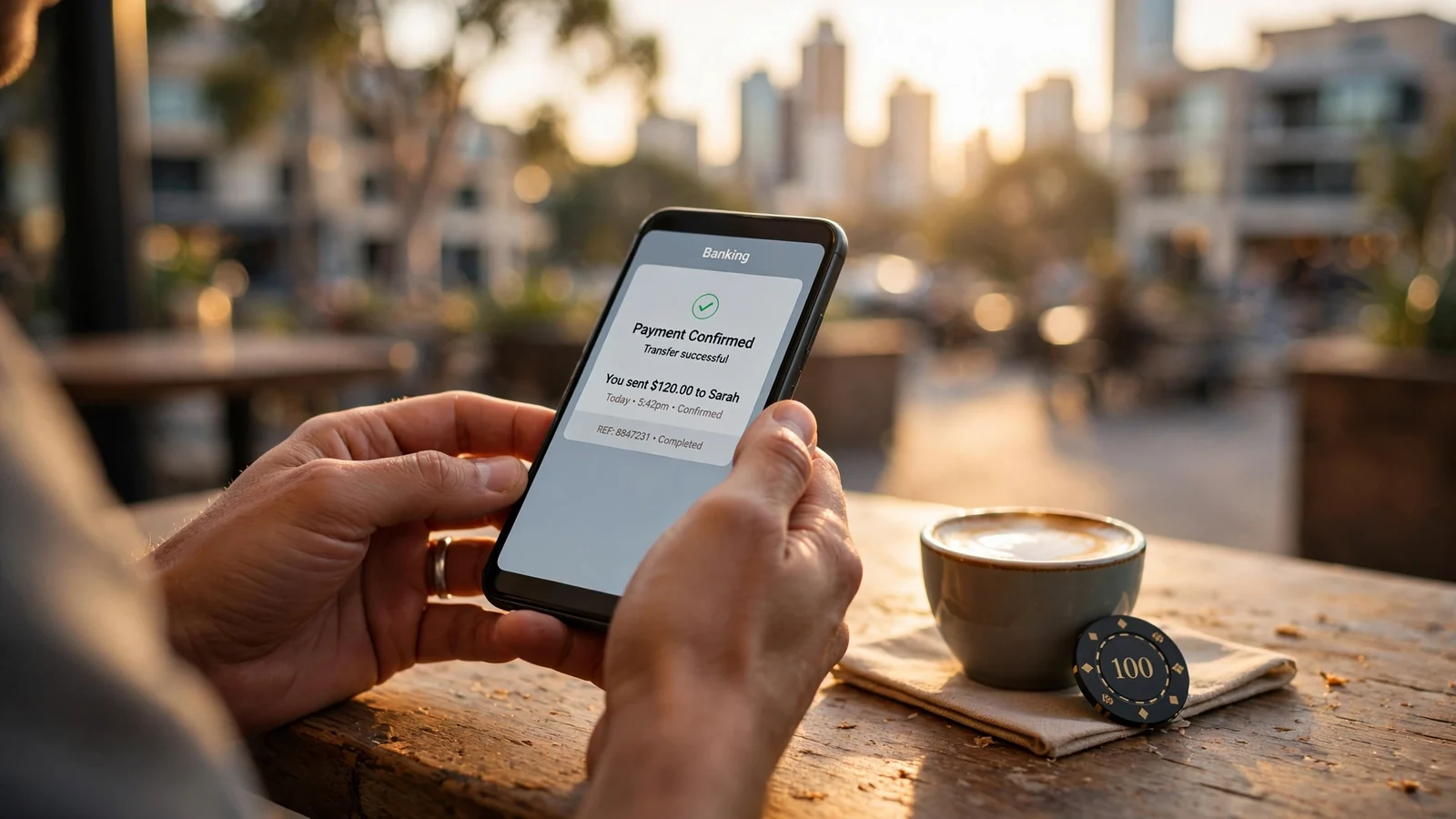
A PayID deposit can feel like a small, routine bank transfer. The important difference is what happens after you confirm it: a PayID transaction cannot be reversed. Treat the confirmation screen as the point of no return, not as a final chance to reconsider.
There is also a legal point specific to Australia. Under the Interactive Gambling Act 2001, it is illegal for operators to provide real-money online casino games, including pokies, to people physically located in Australia. This section is not a recommendation to deposit or a guide to finding a real-money casino. It explains the payment risk behind a common question about PayID and real-money play.
Legal Restriction
Under the Interactive Gambling Act 2001, it is illegal for operators to provide real-money online casino games to people physically located in Australia.
What the minimum tells you — and what it doesn’t
Deposit minimums are set by operators, not by PayID itself. Most operators list a starting deposit somewhere between AU$10 and AU$20. A specialist review has reported that some operators set the starting amount at AU$5, but that lower figure should not be treated as a general rule. Minimums can differ between venues and may change, so a figure seen in a review is not a promise that it will be available when you check.
A low minimum can make a deposit seem modest. It does not make the transaction reversible, establish that a service is lawful, or say anything about whether an operator will handle funds properly. The amount is only one condition attached to a transfer. Read it in that narrow way.
You may also see searches phrased around “AU$10 real-money PayID pokies.” The practical meaning is simply a question about whether a particular operator sets that deposit minimum and accepts PayID. A matching phrase or advertised amount is not proof of either. More importantly, payment convenience does not change the legal status of real-money online casino services in Australia.
Pause before confirming
Before sending any money, check the recipient and the amount on the bank’s confirmation screen. Make sure the transfer details are the ones you intended to use; don’t rely on a familiar-looking label or on a previous transaction. If anything is unclear, stop rather than confirming and hoping to sort it out afterwards.
That pause matters because PayID transfers are final once confirmed. If you change your mind after confirmation, you cannot simply cancel the payment through PayID. A small deposit is still a completed transfer. The same is true whether the amount is near the more common AU$10–AU$20 starting range or a lower minimum reported by a review.


Don’t treat an operator’s minimum as a suggested amount to spend. It is an entry condition, not a measure of affordability or a reason to transfer money. If you are unsure whether a payment is legitimate, or whether the service is lawful, do not confirm it.
Keep the payment decision separate
People often combine several questions into one: whether PayID is available, whether the minimum is low, and whether a real-money casino is suitable to use. Those are different issues. A payment method can be technically available without making the underlying service lawful for Australians. A minimum can be clearly stated without resolving that issue either.
The safest reading of a deposit figure is therefore limited: it tells you what an operator says it will accept as a starting amount, subject to its terms. It does not certify the operator, protect a confirmed transfer, or guarantee an outcome. PayID’s irreversibility makes that distinction especially important.
If you have already confirmed a transfer and are concerned about it, contact your bank promptly and keep the transaction details. Do not assume the payment can be pulled back; confirmed PayID transfers are irreversible. And if you are considering a real-money online casino while physically in Australia, remember that operators are prohibited from providing those services here. A low minimum does not make the risk smaller in any meaningful sense.
PayID Withdrawals: The Casino’s Queue Comes First
A PayID withdrawal has two stages: the casino reviews the request, then it releases the money for transfer. The payment rail may move funds quickly once the operator sends them, but that does not clear the casino’s internal queue. The wait can hinge on the review and whether your identity checks, or KYC, are complete.
Withdrawal Timelines
Specialist reviews report a pending period of 24–72 hours for casino approval, followed by a 12–24 hour transfer time, meaning the full process can take 2–4 days.
If a casino asks for identity documents, an unfinished or unresolved check can hold up approval. Before any withdrawal request, make sure the name on your bank account matches the name on your casino profile. A mismatch can create another obstacle when the operator checks the payment details.
Some specialist reviews describe casino-initiated withdrawals as having a pending period of 24–72 hours before funds leave the operator’s system. That is a reported practice, not a fixed PayID rule: the casino controls when it approves and releases a payout. The same reviews report that the transfer after approval may take 12–24 hours, with the full wait from request to receipt sometimes reaching 2–4 days. Treat those figures as guidance from reviews, not a promise about any particular service.
So if you are looking at PayID withdrawal pokies, separate “approved” from “paid”. A request sitting in the casino’s account history may still be pending; it has not necessarily reached your bank. Check the withdrawal status and any message asking for further verification before assuming the transfer itself is delayed.
PayID acceptance does not establish that an operator is lawful in Australia, fair, or willing to pay winnings. Under the Interactive Gambling Act 2001, providing real-money online casino games to people in Australia is illegal for operators. A familiar payment option does not change that legal position.
If a payout is taking longer than the operator’s stated process, contact its support channel and ask whether the request is awaiting review, KYC, or release. Keep the request details and replies. The queue comes first.


PayID Casino Sites: Check the Cashier Before You Sign Up
A payment badge on a promotional page is not enough to establish that PayID is available. If you are assessing a site’s claims, look for PayID in its cashier or payment-method information before creating an account. The cashier is where the operator’s stated deposit options should be shown; if PayID is absent, do not assume it will appear after registration.
Check that the information refers to deposits, rather than withdrawals alone. A payment method may be presented in general terms while the cashier lists different options for money going in and money coming out. Read the wording carefully, and treat a vague claim as unconfirmed. I would not create an account just to find out whether the advertised method is actually offered.
A specialist review reports that minimum deposits at reputable sites accepting PayID fall in the A$10–A$30 range. That is a reported range, not a promise about any particular site or a guarantee that the cashier’s terms have stayed the same. The operator’s own payment information is the relevant place to check what it currently states.
There is a more important Australian-specific point. Under the Interactive Gambling Act 2001, providing real-money online casino games to people physically in Australia is illegal for operators. A cashier showing PayID does not change that legal position, establish that a service is locally authorised, or make it suitable to use. The phrase “licensed PayID pokies” should not be read as proof of a local licence.
Verifying PayID Availability
- Locate the cashier or payment-method page before registering
- Confirm PayID is listed specifically for deposits
- Note the stated minimum deposit amount
- Verify if the payment information is accessible without an account
So keep the check narrow: confirm whether PayID is actually listed, note the stated deposit minimum, and do not treat either detail as an endorsement. If the payment information is inaccessible until after registration, you cannot verify availability beforehand. That is a reason to stop, not a reason to guess.
Comparing PayID Options Without Mistaking Convenience for Trust
PayID can make a transfer feel straightforward, but that says little about the business receiving it. If you are comparing payment terms, keep the questions separate: what PayID itself charges, what the operator may charge, and whether the service is lawful and trustworthy are not the same issue.
There is an important Australian context first. Under the Interactive Gambling Act 2001, operators cannot legally provide real-money online casino games, including pokies, to people physically located in Australia. A site displaying PayID—or claiming an overseas licence—does not change that position. PayID is a payment method, not evidence that a casino is locally authorised.
Separate PayID fees from operator terms
PayID itself does not charge a transfer fee. Reputable venues do not add a separate charge for PayID deposits or withdrawals, but an operator’s own terms may still describe charges connected with transactions. Read those terms rather than assuming that “free PayID” means every part of the payment process is cost-free.
When reviewing a cashier or payment policy, look for clear wording about fees and any conditions that could affect the amount credited or returned. If the terms are vague, difficult to find or inconsistent across pages, that is a reason to pause—not a reason to assume the most favourable interpretation. Convenient payment does not make unclear conditions acceptable.

Also separate a transfer charge from other payment rules. A fee is only one part of the arrangement; the operator may set its own conditions for accepting or processing payments. I would not judge a service by a PayID logo alone. Small detail, big difference.
Treat confirmation as a commitment
A confirmed PayID transaction cannot be reversed through PayID. Before approving a transfer, check the recipient details and amount carefully, and make sure you understand who is receiving the money. If anything looks unfamiliar or the payment instructions change unexpectedly, stop and verify them independently before continuing.
That irreversibility matters when comparing options. A fast payment is not automatically a safe payment, and a successful transfer does not prove that the recipient will handle a later dispute fairly or return funds when requested. The payment rail can move money; it cannot certify the operator’s conduct.
Avoid treating a payment method as a way to recover a mistaken or unwanted transfer. Once confirmed, the transaction is final from PayID’s perspective. That is why the decision should come before the confirmation step, not after it.
What PayID cannot tell you
Seeing PayID listed does not establish that an operator is licensed to serve Australian customers, that its games are fair, or that it will pay winnings. Those are separate claims, and a cashier listing cannot verify them. Nor does a smooth deposit demonstrate how a withdrawal or complaint would be handled.
Attention: A confirmed PayID transaction cannot be reversed, and a payment method’s availability does not certify an operator’s legality or fairness.
For Australian readers, the legal distinction is not a minor footnote: real-money online casino services for people in Australia are prohibited under the national law. A foreign licence does not create local authorisation. I won’t rank or recommend casino sites on the basis of their payment options.
If you encounter a service presenting PayID acceptance as proof of safety, treat that claim with caution. Ask what the claim actually demonstrates. At most, it indicates that the service says it can receive or send a payment through PayID; it does not answer the questions about legality, fairness or the operator’s obligations.
A practical comparison checklist
Before treating any payment terms as meaningful, check whether the wording is easy to locate and internally consistent. Look for:
- whether a PayID-related fee is stated separately from other operator charges;
- whether the recipient and payment instructions are clear before confirmation;
- whether the terms explain how payment disputes are handled;
- whether claims about licensing can be independently verified, rather than inferred from a payment logo.
Do not let a short cashier description stand in for the full terms. If the conditions are missing or unclear, you cannot make a sound comparison from the payment method alone. And if a site’s pitch depends on PayID making it “trusted,” that is marketing language, not proof.
The useful comparison is not which casino looks easiest to fund. It is whether you understand the payment conditions and recognise what those conditions cannot establish. In Australia, that includes the legal status of the service itself. Convenience is not a safeguard.
PayID Limits and Minimums for Australian Players
A PayID transfer limit and a casino’s deposit minimum are different things. The bank limit sets how much you can send through PayID in a day; the casino minimum is the smallest amount its cashier will accept for a deposit. Meeting one does not mean you meet the other.
A specialist review reports that the player’s bank sets the daily PayID transfer limit. That means the amount available to transfer is determined on the banking side, not by the casino’s stated minimum. If a transfer is larger than your bank’s limit, the casino’s lower minimum will not change what your bank permits. Check your own bank’s current terms for the limit that applies to your account.

A specialist review puts typical PayID deposit minimums at AUD 10–20, but that range is an operator-side condition, not a standard set by PayID or by your bank. The exact minimum can vary between operators, so do not treat a reported range as a promise about a particular cashier.
Here is the practical distinction: the bank controls the daily amount you may send; the operator controls the smallest deposit it says it will accept. Those thresholds answer separate questions. A transfer can be within your bank’s limit yet fall below an operator’s minimum, or meet the operator’s minimum while exceeding what your bank allows for the day.
There is also a legal point specific to Australia. Under the Interactive Gambling Act 2001, operators are prohibited from providing real-money online casino games, including pokies, to people physically located in Australia. A payment method or a stated deposit threshold does not alter that restriction. I would not treat a PayID limit as a reason to transfer money to an online casino.
Free Credits and PayID: Read the Bonus Terms First
A “free credit” attached to a PayID pokies claim is an operator’s bonus offer, not a benefit supplied by PayID. PayID is a way to transfer money; it does not create credits or guarantee that an offer is genuine. Treat the wording as a claim to check, not a reason to sign up or deposit.
Common bonus conditions
Specialist casino reviews report wagering requirements typically ranging from 30x to 45x the bonus amount. It is important to check the maximum bet limit, eligible games, and expiry conditions, as exceeding limits may void winnings.
If you encounter a bonus offer, read its terms before acting. Specialist casino reviews report wagering requirements in the range of 30x to 45x the bonus amount. That figure describes reported offers, not a rule that applies everywhere. Check what amount the wagering is calculated against, which games count, and any expiry or withdrawal conditions stated in the offer.
Pay particular attention to the maximum bet while wagering requirements apply. If you exceed the stated limit, the operator may void the bonus and associated winnings. A headline credit can look generous until the conditions make it difficult to use.
There is a more basic point for anyone in Australia: the Interactive Gambling Act 2001 prohibits operators from providing real-money online casino games, including pokies, to people physically located here. Calling an offer “free” does not change the nature of the service or make it lawful for an operator to provide.

I would not treat a PayID label, a social post or a forum discussion as proof that credits are available or that an offer is safe. Read the terms themselves, and do not let a bonus push you into sending money. Bonuses are conditions first, credits second.
How to Confirm a Site Accepts PayID
If you are checking whether a site lists PayID, go straight to its cashier or payments page before creating an account. Look for PayID among the available deposit methods, rather than relying on a banner, a social post or a claim on another page. Payment options can change, and a general mention does not confirm that the method is currently available in the cashier.
Check the wording carefully. A page might mention PayID without showing it as an option for deposits. If the cashier is visible without registration, that gives you a direct check. If it is not, do not treat an unsupported claim elsewhere as confirmation.

A specialist review reported that minimum deposits at sites accepting PayID can fall between A$10 and A$30. Treat that as a reported range, not a promise about any particular site; the cashier’s stated terms are the relevant place to verify its current requirements. A payment logo alone tells you nothing about the minimum or whether the option is available to you.
There is a more important limit to this check in Australia. Under the Interactive Gambling Act 2001, providing real-money online casino games, including pokies, to people in Australia is illegal for operators. A PayID listing does not make such a service lawful, nor does it establish that a site is safe or will pay out. Keep those questions separate from the narrow one the cashier can answer: whether PayID is listed as a payment option.
Facebook PayID Pokies Claims: What You Can Verify
A Facebook post saying a casino takes PayID does not prove that the payment option is available, or that an advertised offer is genuine. Posts can be out of date, incomplete or unrelated to the operator’s own terms. I would treat them as claims, not confirmation.

If you are checking what a post says, the operator’s cashier is the place to see whether PayID is listed as a payment option. That only confirms what the cashier displays; it does not establish that the operator is trustworthy, that an offer will be honoured, or that winnings will be paid. Read the terms directly rather than relying on a screenshot or a comment under the post.
There is an important legal point for Australians: under the Interactive Gambling Act 2001, operators are prohibited from providing real-money online casino games, including pokies, to people physically located in Australia. A social-media post does not change that.
Be wary of being hurried into sharing personal or banking details through a post or message. Don’t treat a claimed PayID option as a reason to sign up, transfer money or trust an offer. If a post makes a promise, verify what it actually says through an official channel—and remember that payment availability is not proof of safety.
How do you deposit money into an online casino using PayID?
Select PayID in the payment form, follow the transfer instructions, and check the recipient details before confirming. Your PayID must be registered with your bank, and the account name should match your casino profile. In Australia, PayID does not make an online casino lawful to offer real-money pokies.
Do online casino sites in Australia use PayID?
Some online casino sites accept PayID transfers from Australian bank accounts. This payment option does not mean the operator is licensed or permitted to offer real-money pokies to people in Australia.
Can you withdraw casino winnings using PayID?
Yes, PayID supports transfers in both directions. A casino may review a withdrawal before approving it; after approval, the transfer usually reaches your account within the same day.
Is it legal to play pokies using PayID in Australia?
No. Under Australia’s Interactive Gambling Act 2001, operators are prohibited from providing real-money online casino games, including pokies, to people physically located in Australia. Using PayID does not change that.
How long do PayID deposits take to appear in your casino account?
PayID deposits are typically completed within seconds. The receiving business may take additional time to process the payment after the transfer arrives.
What security measures are in place at casino sites that use PayID?
PayID transfers are made through your bank, and using the identifier does not give the casino your banking credentials. Check the recipient details before confirming, because a confirmed PayID transaction is irreversible.
Can you play pokies using PayID?
PayID is a way to transfer money, not a game feature. In Australia, operators are prohibited from providing real-money online pokies to people physically located in the country, and PayID does not create an exception.
Published by the Wildfortunecaasino.net team.